Parts of a Motherboard and Their Functions
The main motherboard components and their functions include the CPU socket, chipset, RAM slots, PCIe slots, SATA ports, M.2 connector, power delivery, voltage regulator module, BIOS chip, CMOS battery, rear I/O ports, front panel connectors, and fan headers. Each part helps connect, power, or control the rest of the computer hardware.
A motherboard is the main printed circuit board inside a desktop computer. It is also called a mainboard, system board, or logic board. It routes power and data between the processor, memory, storage drives, expansion cards, cooling fans, and external ports, so every major component can work together as one system.
Motherboard Components
The table below lists the key components of a motherboard, the names you may see in manuals or search results, and the job each one performs.
| Motherboard Part | Common Terms | Main Function |
|---|---|---|
| Processor connection | CPU socket, motherboard socket, processor socket | Holds the processor and provides its electrical connection to the board |
| Traffic control | chipset, platform controller hub, northbridge, southbridge | Manages data flow between the processor, memory, storage, USB, and I/O |
| Memory area | RAM slots, memory slots, DIMM slots, DDR, DRAM | Holds RAM modules used for active programs and data |
| Expansion area | PCIe slots, PCI Express slots, PCI slots, AGP slots | Accepts expansion cards such as a graphics card, network card, capture card, or sound card |
| Storage connections | SATA ports, M.2 connector, NVMe, IDE, PATA | Connects hard disks, SSDs, optical drives, and other storage devices |
| Power delivery | 24-pin ATX connector, CPU power connector, VRM, MOSFETs, chokes, capacitors | Brings power onto the board and converts it to stable voltages for components |
| Firmware and clock | BIOS chip, UEFI, BIOS battery, CMOS battery, RTC | Initializes hardware during boot and keeps firmware settings and the system clock saved |
| External and internal connections | I/O ports, USB ports, Ethernet port, audio jacks, front panel header, fan headers | Connects the board to peripherals, case buttons, LEDs, and cooling fans |
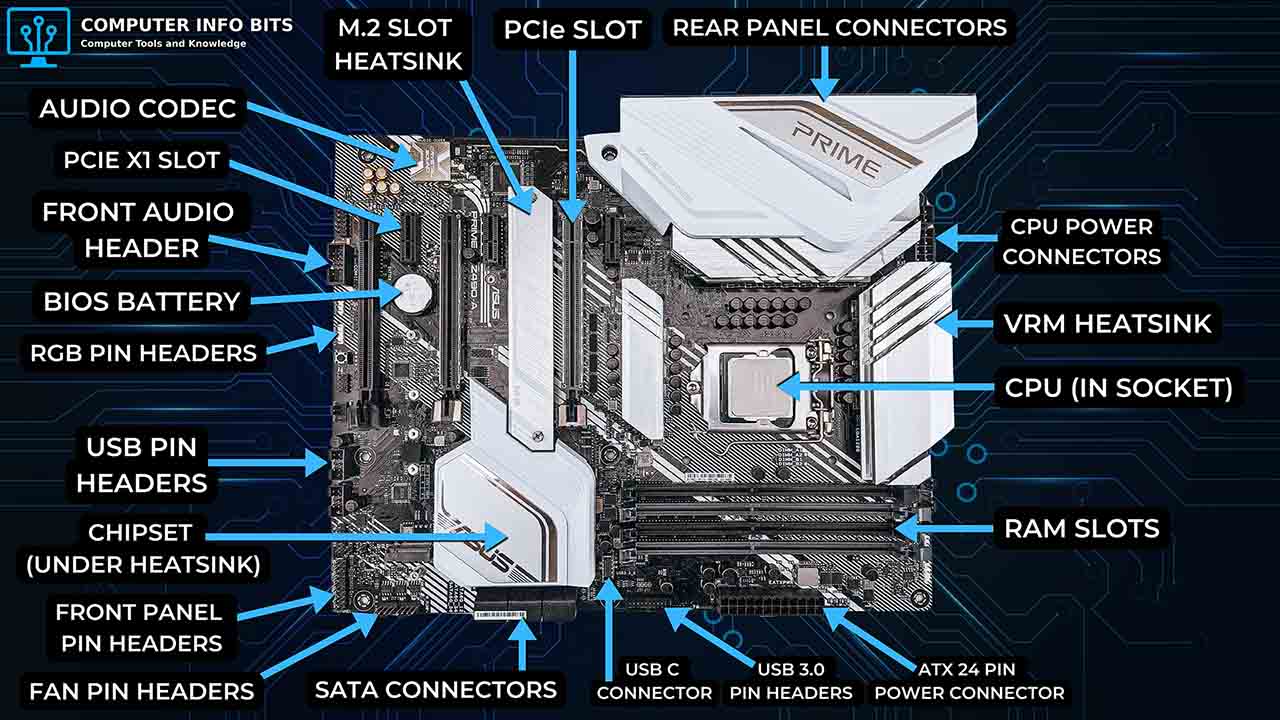
CPU Socket
The CPU socket is the large connector that holds the processor on the motherboard. It provides the physical mount and the electrical contact points that let the CPU communicate with the rest of the system. When people talk about motherboard compatibility, the socket is one of the first things they mean.
Different CPU sockets support different processor families. Intel commonly uses LGA sockets, where the contact pins live on the motherboard socket. AMD used PGA on older platforms and now also uses LGA on modern desktop platforms. If the socket does not match the processor, the chip will not fit and the board will not work.
- CPU socket: Holds the processor and links it to the motherboard traces
- LGA: Places the contact pins on the motherboard socket
- PGA: Places the pins on the processor instead of on the board
- Socket compatibility: Determines which processors the board supports
Chipsets
The chipset controls communication between the processor, storage devices, USB ports, expansion slots, and other motherboard features. On modern boards, the chipset works alongside the CPU to allocate PCIe lanes, SATA ports, M.2 slots, USB connectivity, and other I/O functions.
Older motherboards split this job between the northbridge and southbridge. The northbridge handled high-speed communication between the CPU, RAM, and graphics interface, while the southbridge handled slower functions such as USB, audio, and storage. Modern boards no longer use separate northbridge and southbridge chips, but those terms still appear in older motherboard documentation.
The chipset affects how many USB ports, SATA ports, M.2 slots, and expansion options a motherboard can provide. Two boards may use the same CPU socket but offer very different storage layouts, motherboard ports, and PCIe slot configurations because their chipsets are different.
RAM and Memory Slots
The memory slots, also called RAM slots or DIMM slots, hold the memory modules used by the system. These slots connect RAM to the motherboard so the processor can read and write active data quickly.
Modern desktop boards use DDR memory. The two common desktop standards are DDR4 and DDR5. Because each DDR generation uses a different notch position and electrical standard, a DDR4 module will not fit a DDR5 board, and a DDR5 module will not fit a DDR4 board.
Most consumer motherboards include two or four memory slots. Installing matched RAM modules in the correct slots enables dual-channel operation, which increases memory bandwidth. The motherboard manual usually shows which pair of slots to use first.
- Memory slots: Physical sockets for RAM modules
- DIMM: The standard desktop memory module format
- DDR: The memory standard used by modern desktop motherboards
- Dual-channel: Uses a matched pair of memory slots for more bandwidth
Expansion Slots
Expansion slots let the motherboard accept add-in cards. The current standard is the PCIe slot, also called a PCI Express slot. A PCIe slot can hold a graphics card, network card, sound card, USB expansion card, storage controller, capture card, or other expansion card.
PCIe slots come in several physical sizes and lane widths, including x1, x4, x8, and x16. A graphics card normally uses the main x16 slot closest to the CPU socket. Smaller cards often use x1 or x4 slots.
Before PCIe became standard, motherboards commonly used PCI slots for general expansion and AGP slots for graphics. PCI slots were often used for sound cards, modems, network cards, and RAID cards. AGP slots were used mainly for video cards. These older slot types are now legacy features, but the names still appear in repair guides and older board manuals.
Storage Connectors
Motherboards need storage connectors so the system can communicate with hard disks, solid-state drives, and optical drives. On modern boards, the two main storage standards are SATA ports and the M.2 connector.
SATA Ports
SATA ports connect traditional hard disks, SATA SSDs, and optical drives to the motherboard. Each SATA drive uses a separate data cable, while drive power comes from the power supply rather than from the board itself. SATA replaced the older IDE and PATA standards, which used wide ribbon cables.
M.2 Connector and NVMe
The M.2 connector is a compact socket that lets an SSD plug directly into the motherboard. Many M.2 slots support NVMe, which communicates over PCIe lanes and offers much higher performance than SATA.
Some M.2 slots share bandwidth with certain SATA ports. That means installing an NVMe drive can disable one or two SATA ports on some boards, depending on the motherboard layout.
Important: Check the motherboard manual if you plan to use several SATA ports and several M.2 drives together. Some slots share chipset lanes and cannot all operate at the same time.
Power Connectors and VRM
The motherboard receives power through its main 24-pin ATX power connector and an additional CPU power connector, often 8-pin. The 24-pin connector supplies general board power, while the CPU power connector supplies dedicated power to the processor area.
Near the CPU socket sits the voltage regulator module, usually shortened to VRM. The VRM converts power supply voltage into the lower, stable voltages the CPU and nearby components need. This circuit uses MOSFETs, chokes, and capacitors.
Better boards often use larger heatsinks over the VRM area. These heatsinks help remove heat from the power circuitry, which matters most with higher-power processors or long heavy workloads.
- 24-pin ATX connector: Main board power input
- CPU power connector: Extra connector that feeds the processor area
- Voltage regulator module: Steps voltage down to a safe, stable level for the CPU
- VRM heatsinks: Help cool the motherboard power delivery circuitry
BIOS Chip and CMOS Battery
The BIOS chip stores the firmware that initializes the motherboard when the system starts. Modern boards usually use UEFI firmware, but many people still call it BIOS. This firmware checks the hardware, prepares the system for boot, and hands control to the operating system.
The CMOS battery, also called the BIOS battery, keeps firmware settings and the real-time clock saved when the computer is turned off. If the CMOS battery fails, the system clock may reset and BIOS settings may return to defaults.
Clearing the CMOS resets saved firmware settings. Many boards let you do this by removing the battery briefly, moving a clear-CMOS jumper, or pressing a clear-CMOS button if the board provides one.
- BIOS or UEFI: Firmware that starts the hardware before the operating system loads
- CMOS battery: Keeps firmware settings and the clock saved when the PC is off
- Clear CMOS: Resets firmware settings when a configuration prevents normal startup
I/O Ports and Back Panel
The rear I/O panel is the group of motherboard ports on the back of the computer. These external ports connect the board to devices such as keyboards, mice, monitors, speakers, microphones, network cables, and USB storage.
The exact port mix depends on the chipset, board tier, and whether the motherboard includes integrated wireless networking. A modern board usually provides several USB ports, an Ethernet jack, audio jacks, and display outputs for processors with integrated graphics.
- USB ports: Connect keyboards, mice, storage devices, and other peripherals
- Ethernet port: RJ-45 network connection for wired networking
- Audio jacks: Connect headphones, speakers, microphones, and line-level audio
- Display outputs: HDMI, DisplayPort, DVI, or VGA for processors with integrated graphics
- PS/2: Legacy port sometimes used for older keyboards or mice
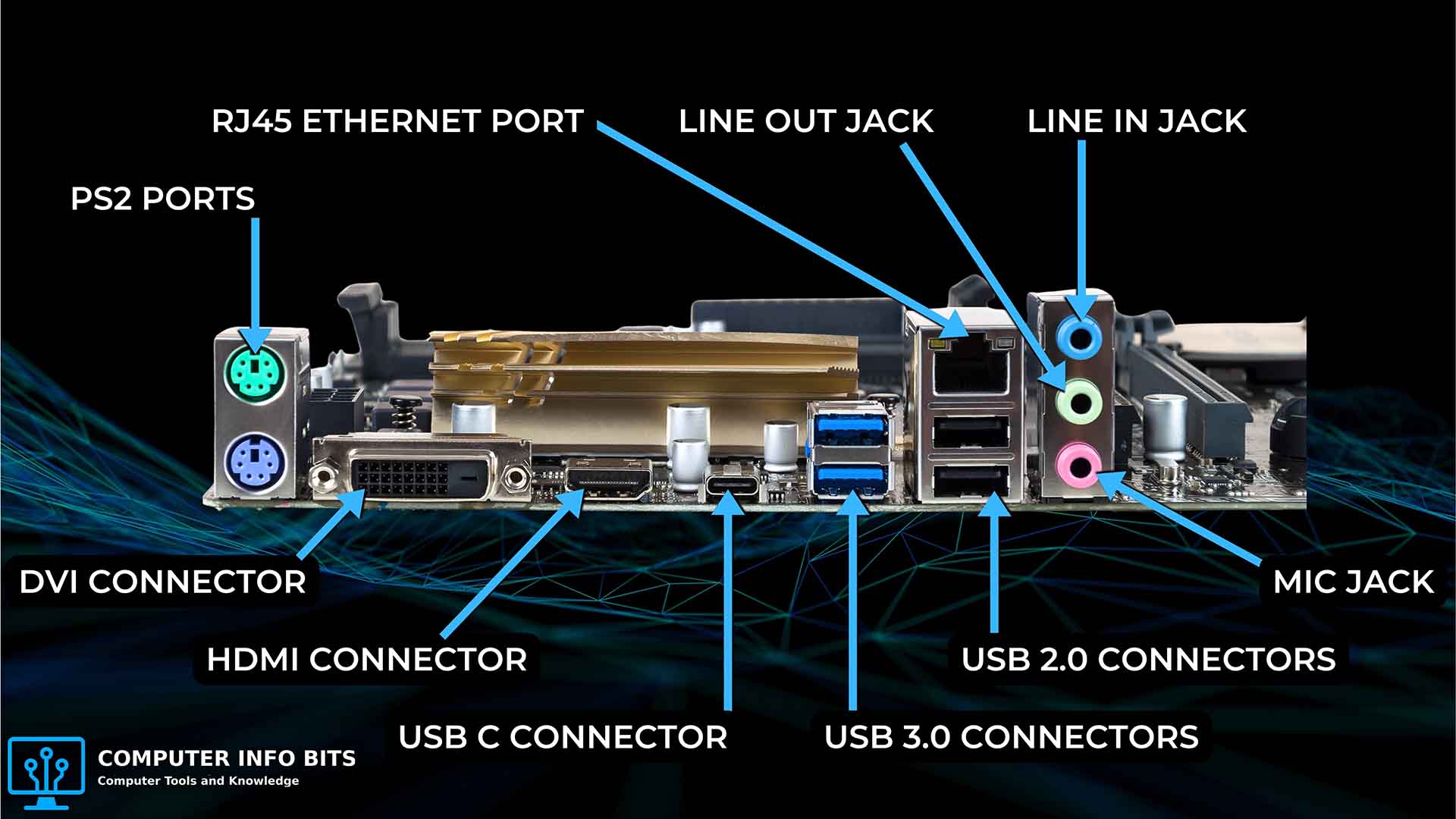
On many motherboards, the network interface card and audio hardware are integrated directly into the board. That is why Ethernet and audio ports are usually present even when no separate network or sound card is installed.
Front Panel Connectors and Headers
The front panel connectors are the small pins that connect the computer case buttons and LEDs to the motherboard. This area is also called the front panel header. These pins usually sit along the bottom edge of the board.
- Power switch: Turns the system on or starts shutdown
- Reset switch: Restarts the system without cutting main power
- Power LED: Shows system power status
- Drive activity LED: Shows hard disk or SSD activity
- Speaker pins: Can provide POST beep codes on some systems
More Internal Headers
Motherboards also include other internal headers such as fan headers, USB headers, front-panel audio headers, and RGB headers. Fan headers power the CPU cooler and case fans so the board can monitor and control system cooling.
If the front panel connectors are attached incorrectly, the system may fail to power on even though the rest of the board is installed correctly. That is why the front panel header is one of the first places to check when a newly assembled PC will not start.
Motherboard Types and Form Factors
Motherboard types are defined by their form factor, which sets the physical size, mounting-hole pattern, and general layout of the board. The most common desktop form factors are ATX, Micro-ATX, and Mini-ITX.
Form factor affects how many memory slots, PCIe slots, storage connectors, and rear ports a board can physically fit. It also determines which computer cases the motherboard can be installed in. A larger board can provide more expansion room, while a smaller board saves space but usually has fewer slots and connectors.
- ATX: Standard desktop size with the most expansion room
- Micro-ATX: Smaller than ATX, usually with fewer PCIe slots
- Mini-ITX: Compact board size, usually with two RAM slots and one PCIe slot
The motherboard is the main PCB inside a desktop computer. Its components include the CPU socket, chipset, RAM slots, PCIe slot area, SATA ports, M.2 connector, power delivery, BIOS chip, CMOS battery, rear I/O ports, front panel header, and internal headers.
Understanding these motherboard components makes it easier to match a processor to the right socket, install RAM in the correct memory slots, choose compatible drives, connect case buttons, and identify the right headers and ports when you build or troubleshoot a system.
Related Posts
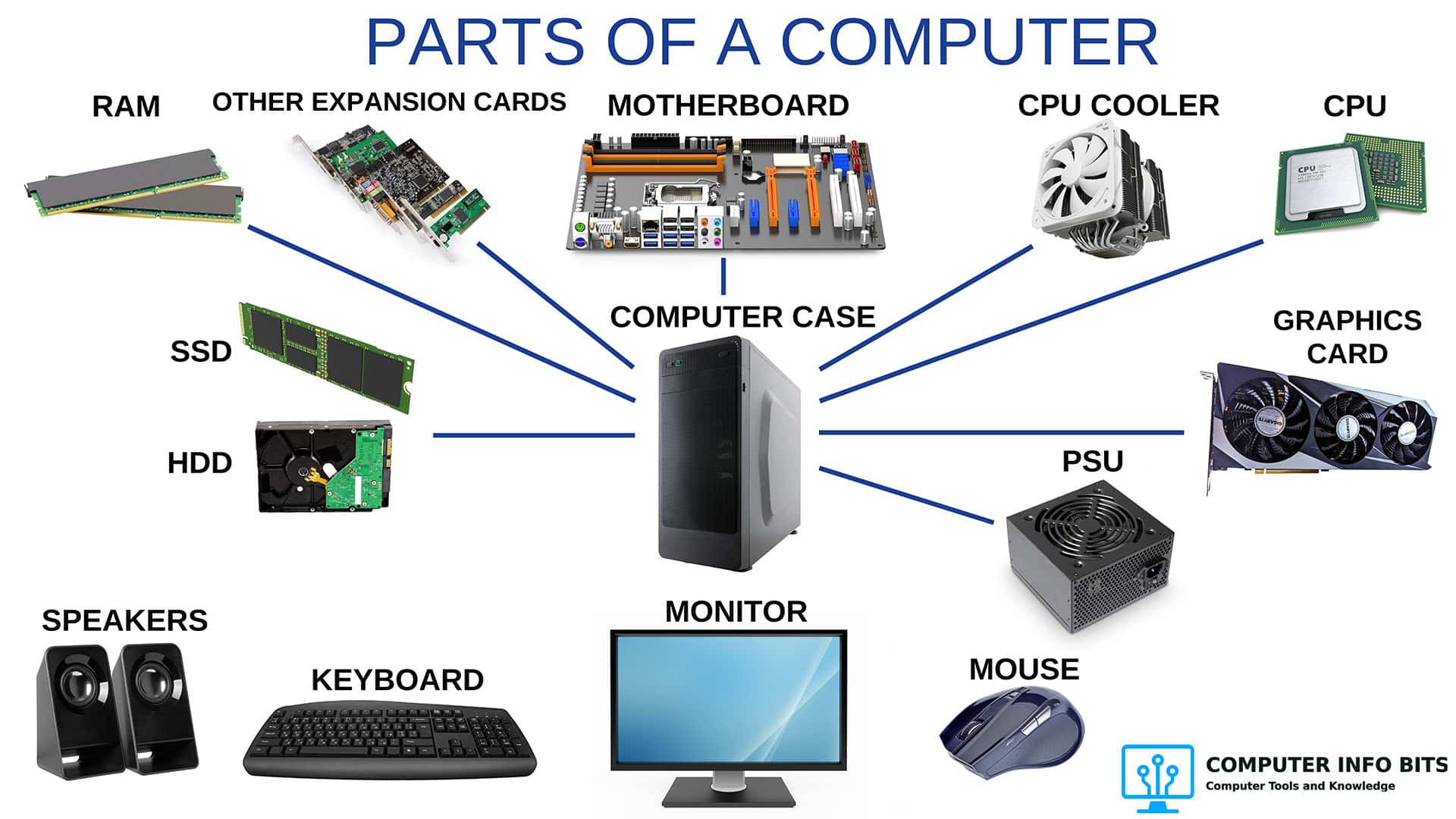
Parts of a Computer and Their Functions
A complete breakdown of every major PC component including the CPU, RAM, and GPU.
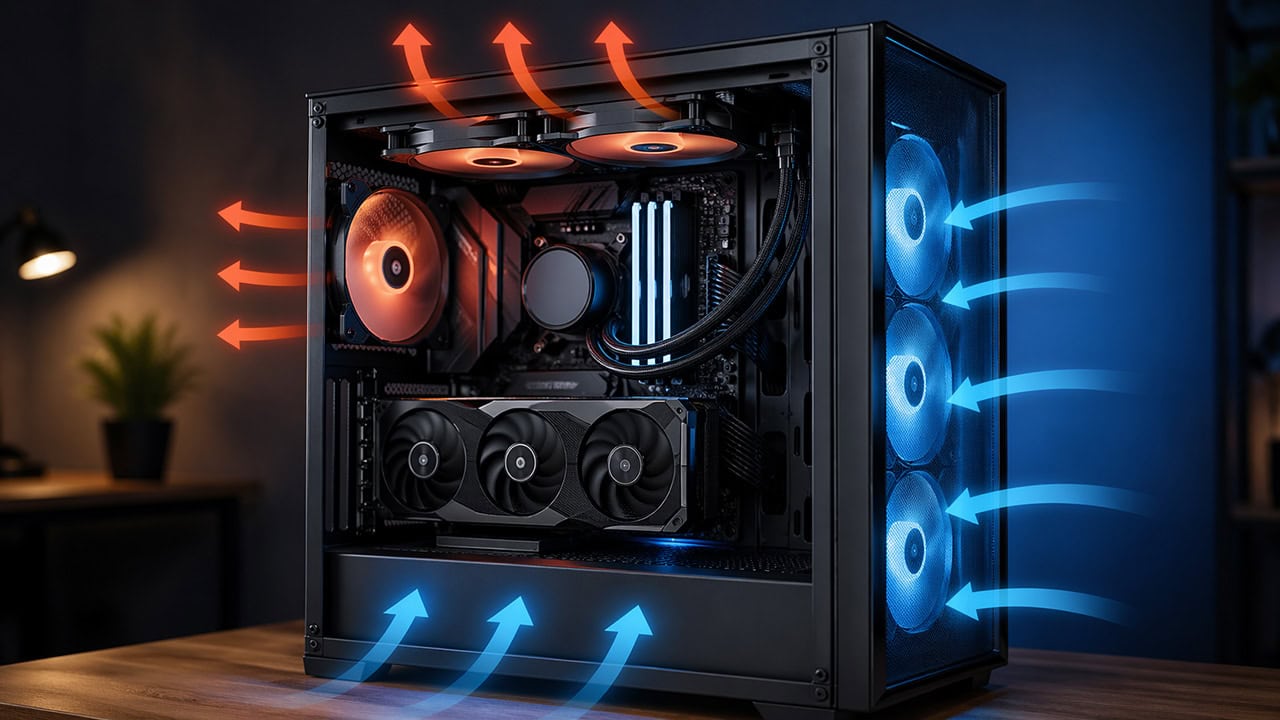
PC Airflow Optimization
Set up your case fans correctly to keep temperatures low and reduce dust buildup.
How to Check if a GPU Is Working Properly
Test your graphics card using Task Manager and MSI Afterburner.
What Is a Monitor and the Various Types
A complete guide to monitor panel types, resolutions, and refresh rates.